


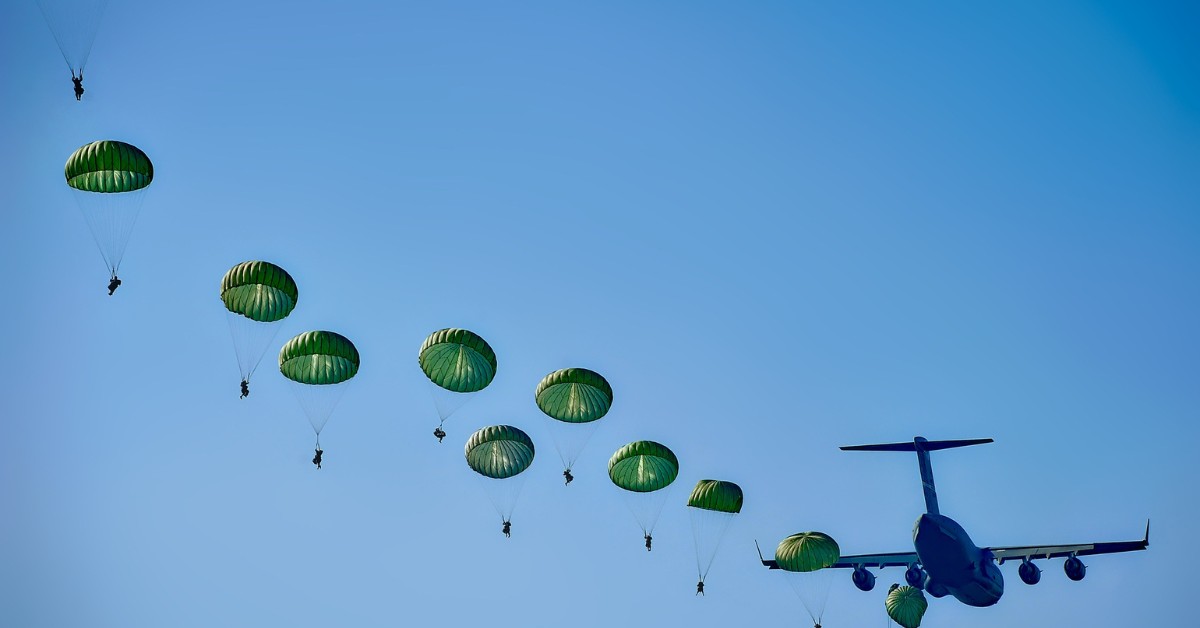
Wondering why don’t planes have parachutes for passengers is completely natural—especially if you’re nervous about flying. Your mind wants a Plan B. It seems logical: if something goes wrong, why can’t you just jump out? But the truth is, that idea, while instinctive, doesn’t match the reality of how commercial aviation works. Not only are parachutes ineffective in this context, but they’d actually introduce far more danger than safety.
Let’s break it down.
Parachutes Aren’t Built for This Environment
Commercial airliners cruise at heights of over 30,000 feet. At that altitude, the air is dangerously thin, freezing cold—often below -50°F—and oxygen levels are far too low to survive without specialized equipment. Military parachutists prepared for high-altitude jumps wear pressurized suits and oxygen masks. Passengers on a commercial flight? They don’t have that gear—and more importantly, there wouldn’t be time to train them to use it in an emergency.
And then there’s speed. Airliners fly at around 500–600 mph. Jumping out into that airflow would be like hurling yourself into a tornado. It would not be easily survivable for most people.
No Safe Way to Jump
Aircraft doors don’t open mid-flight the way you’ve seen in movies. Cabin pressure keeps them sealed until the plane is safely on the ground or extremely low altitude. To open a door at cruising altitude, you’d have to depressurize the cabin—a catastrophic move that affects everyone onboard.
Even if it were possible to open the door safely, imagine hundreds of untrained passengers trying to exit a moving aircraft in sequence, under stress, with zero jump training. The logistics alone make it unworkable. Controlled evacuations on the ground are already carefully timed. Now add wind speeds, cold, hypoxia, and panic. It’s not survival—it’s chaos.
Here’s What Pilots Are Trained to Do Instead
Your flight crew is not relying on parachutes—they’re trained to handle almost every imaginable emergency from the cockpit. They have checklists, backup systems, alternate routes, and—most importantly—experience. They know how to get the plane down safely, not midair, but on a real runway.
Pilots are constantly in communication with air traffic control. If an emergency happens, they have direct access to priority landing permissions, weather updates, and airport emergency teams. They are never left to figure things out alone.
Pilots don’t think ‘how do I escape?’—they think ‘how do I land safely?’
Let’s Bust a Big Myth
Movies and TV have fed us dramatic images of pilots or skydivers bailing out in emergencies. That visual imprint sticks. But commercial aviation isn’t built for movie scenes—it’s built for containment, control, and resolution. The goal is never to jump. It’s to land.
Jumping out is not a backup plan, backup systems are built directly into the aircraft itself.
Why Planes Are Safer Without Parachutes
Each extra nonessential pound on a plane reduces efficiency and complicates design. Parachutes are bulky, heavy, and would require fittings and training for every passenger. Worse, they would add a false sense of security—something that could lead to dangerous decisions in a real emergency.
Instead, airlines invest in preventive maintenance, crew training, and advanced engineering that keep the chances of needing that kind of emergency action vanishingly small. Jumping isn’t the solution. It’s not even a good option.
If it helped save lives, aviation would use it. But it doesn’t. So it doesn’t.
Perspective from Your Side of the Aisle
If you’re holding onto the idea of parachutes because you want control, you’re not alone. Fear of flying often stems from the feeling that someone else is at the controls—you’re not in charge of your next move. That’s where knowledge helps.
Rather than imagining yourself needing to escape at 35,000 feet, imagine this: highly trained professionals turning toward a safe alternate airport, guided by multiple systems, supported by ground teams—and designed to land even if one part of the system goes down.
The best escape plan is a safe landing—not a jump.
Knowledge is your co-pilot. You’ve got this!
Fearless Flight Club
